
The Intersection of IoT and HCI: Managing Billions of Distributed Assets

Exploring real-world use cases where IoT asset integration meets datacenter intelligence

The rapid expansion of the Internet of Things (IoT) is driving exponential growth in distributed devices sensors, controllers, robots, and machines that generate, transmit, and analyze data at scale. By 2030, billions of IoT assets will require secure, resilient, and intelligent management. Yet traditional IT infrastructure lacks the efficiency, mobility, and intelligence to support this scale across diverse industries and geographies.

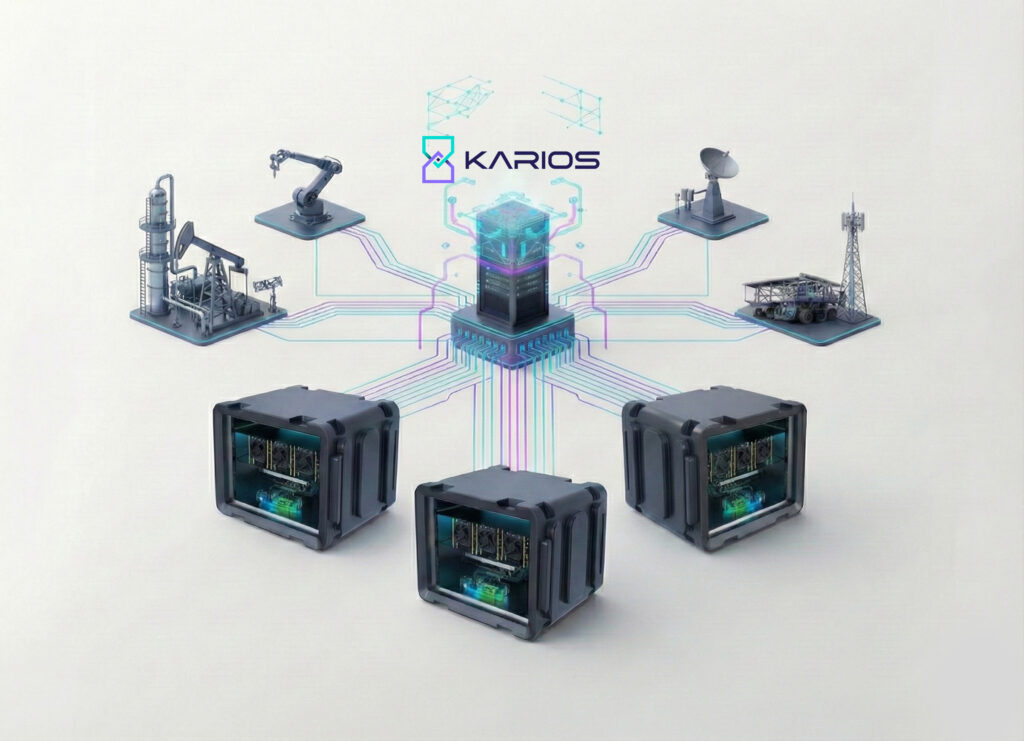
This whitepaper introduces a next-generation approach at the intersection of Hyperconverged Infrastructure (HCI) and IoT, powered by our patented operating system, hypervisor, and hardware solutions. By unifying datacenter-grade intelligence with edge-ready hardware, our Modular Micro-Datacenter, Karios Cube, and Karios PowerLink monitoring suite we enable organizations to deploy and manage billions of IoT assets in real-world environments such as manufacturing, oil & gas, mining, and remote telecom backhaul.
Introduction: The Convergence Imperative

  • IoT Explosion: Manufacturing floors, oil fields, and mining operations are embedding sensors and automation across every process.
  • Challenge: These distributed environments demand low-latency processing, resilience against harsh conditions, and intelligent lifecycle management at scale.
  • Opportunity: Hyperconverged Infrastructure (HCI) designed for IoT not only consolidates compute, storage, and networking but also introduces intelligent provisioning, automatic asset discovery, and integrated security at the firmware and hypervisor levels.

The HCI-IoT Platform Advantage

Our platform extends the promise of HCI beyond traditional enterprise use cases:

  • Intelligent Hardware Provisioning – Zero-touch deployment of IoT-driven compute and storage assets.
  • Automatic Inventory & Asset Discovery – Real-time visibility across millions of distributed IoT devices.
  • Karios Cube– Ruggedized, ultra-efficient, and compact (2’ per side) units that support extreme temperatures, solar power, and 48-hour battery backup.
  • Network Agnostic – Fiber, copper, microwave, 4G/5G, and low-earth-orbit satellite for remote connectivity.
  • PowerLink Energy Management – Inline monitoring for carbon/LEED compliance, cost optimization, and efficiency auditing.
  • Integrated Security – Vulnerability scanning and compliance embedded at the hypervisor and firmware level, critical for safeguarding industrial IoT.

Use Cases: Where IoT Meets HCI

1. Manufacturing: Smart Factories at Scale

  • Problem: Factories rely on thousands of robots, CNC machines, and sensors producing terabytes of data daily. Traditional cloud latency disrupts real-time analytics.
  • Solution: Deploy Karios Cube inside facilities for edge-level compute. Automatic asset discovery ensures every new robot or sensor is recognized and secured.
  • Benefit: Real-time process optimization, predictive maintenance, reduced downtime, and full compliance audits

2. Oil & Gas: Harsh Environments, High Stakes

  • Problem: Offshore rigs and remote drilling sites face connectivity gaps, extreme weather, and safety risks. IoT assets must be managed without centralized datacenters.
  • Solution: Ruggedized Karios Cube with solar support and satellite backhaul ensures always-on IoT processing. Integrated Karios PowerLink enables energy audits for sustainability mandates.
  • Benefit: Improved safety, compliance reporting, operational continuity even during network isolation, and reduced reliance on high-latency cloud links.

3. Mining: Deep Underground, Distributed Above Ground

  • Problem: Mining operations span underground sensors, autonomous vehicles, and environmental monitoring systems. Infrastructure downtime can halt production and risk worker safety.
  • Solution: Deploying Karios Cube at shaft entrances and remote outposts ensures local compute and fast decision-making. Backhaul over satellite or microwave connects operations to HQ.
  • Benefit: Enhanced worker safety, asset tracking, predictive maintenance, and remote monitoring for environmental compliance.

4. Telecom Backhaul for IoT in Remote Areas

  • Problem: Billions of IoT devices in rural healthcare, agriculture, and energy systems remain disconnected due to limited backhaul options.
  • Solution: Karios Cube serves as a localized aggregation hub, supporting multiple access technologies (4G/5G, microwave relay, LEO satellite).
  • Benefit: Extends IoT ecosystems into rural, underserved, or mission-critical geographies, bridging the digital divide and enabling real-time analytics across industries.

Key Differentiators

  • Compact but Hyperscalable: Units can cluster for petabyte-scale processing while remaining mobile.
  • Sustainability First: Inline energy monitoring ensures carbon compliance and operational efficiency.
  • Security at the Silicon: Hypervisor-level scanning prevents malicious actors from hijacking IoT workloads.
  • Resilience in Motion: Solar power and 48-hour battery support guarantee uptime even off-grid.

Conclusion: Enabling the IoT-HCI Future

The intersection of IoT and HCI is not a distant vision—it is a present necessity. By integrating intelligent datacenter management with ruggedized, mobile, and energy-aware hardware, our solution empowers enterprises in manufacturing, oil & gas, and mining to securely manage billions of IoT assets in real-time.

Through telecom backhaul and Karios Cube deployments, we extend IoT connectivity even to the most remote areas, unlocking new frontiers for efficiency, safety, and sustainability.

Call to Action

Organizations that embrace this convergence will outpace competitors in agility, compliance, and operational intelligence. Contact us to learn how our HCI-IoT platform can transform your distributed asset strategy.