
Power has become the most significant obstacle to expansion as data centers continue to expand in order to enable artificial intelligence. It is still common for firms to be “power-blind,” meaning that they store their hardware and electricity in separate silos. Due to this gap, money is wasted, and operational hazards are concealed.
With Karios Powerlink, you can take advantage of a straightforward and practical solution that integrates power monitoring directly into the server path.
By integrating power data into the virtualization layer, Powerlink transforms energy from an unmanaged utility into a strategic, visible asset.
By integrating power data into the virtualization layer, Powerlink transforms energy from an unmanaged utility into a strategic, visible asset.
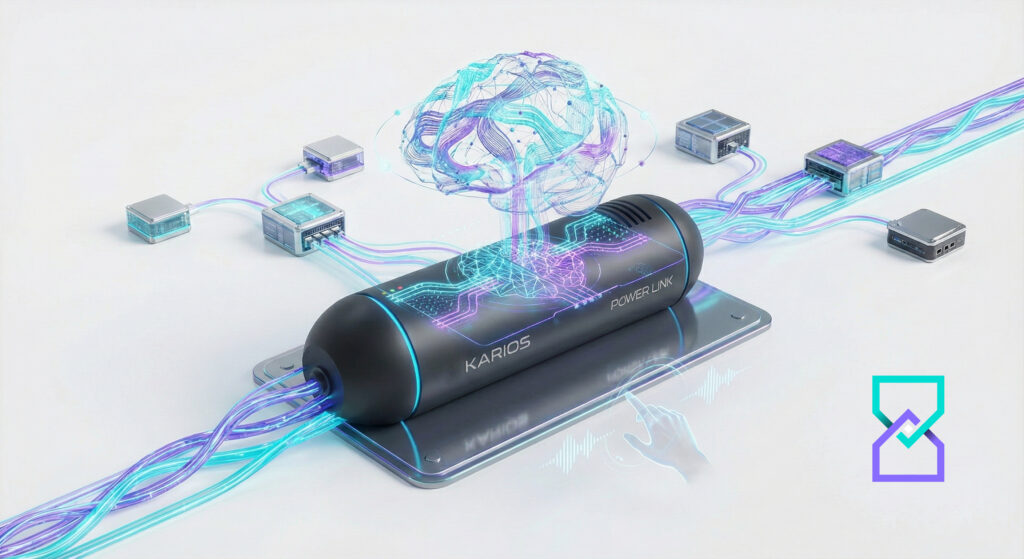
Today, managing data center infrastructure entails dealing with a new world where electricity is one of the biggest problems in IT. It’s not enough now to use traditional methods that keep power management separate from the virtualization layer. Hyperconverged infrastructure (HCI) needs to go beyond just combining things. It needs to handle power as a first-class, quantifiable, and controllable resource.
Karios Powerlink comes in. It’s not just another part; it’s a small, smart gadget that can be put directly into the power path of any server or edge device to monitor power in real time.
At this point in time, when computing, storage, and networking are all coming together as part of a hyperconverged architecture, it is necessary for electricity to also come together. It is difficult to have a clear image of how healthy your infrastructure is when you utilize standard rack-mounted Power Distribution Units (PDUs). This is due to the fact that these PDUs can be cumbersome, expensive, and a separate layer from your virtualization layer.
Because it is fully compatible with Karios Core, Karios Powerlink is able to provide you with administration and visibility across your whole fleet, beginning with the firmware and working its way up. It is now possible for information technology teams to make more efficient use of energy than ever before.
Karios Powerlink provides capabilities that translate into real-world operational benefits.
| The Old Way | The Karios Powerlink Way |
|---|---|
| Fragmented Visibility: Power data is siloed in traditional PDUs, separate from workload data. | Unified Insights: Real-time power data is synchronized with VM scheduling and hardware telemetry. |
| Broad Estimates: Energy usage is tracked at the rack or device level. | Granular Attribution: Energy consumption is measured per-application and per-VM for precise analysis. |
| Reactive Management: Power is monitored for outages and basic usage. | Intelligent Optimization: AI-driven policies and predictive capabilities optimize performance and reduce waste. |
Look, the gear you choose today is the bedrock for whatever your operations face down the road. In this new era of HCI, you can’t afford to keep treating power consumption as just the cost of doing business. Karios Powerlink is built for the long haul, where efficiency, sustainability, and the ability to scale seamlessly aren’t just nice-to-haves, they are essential survival tools.
By integrating real-time monitoring right into the power path, you are finally flipping the script. You are taking energy management off the back burner and turning it into a genuine strategic advantage that works in lockstep with your virtualization layer. It boils down to the core philosophy driving Karios: