
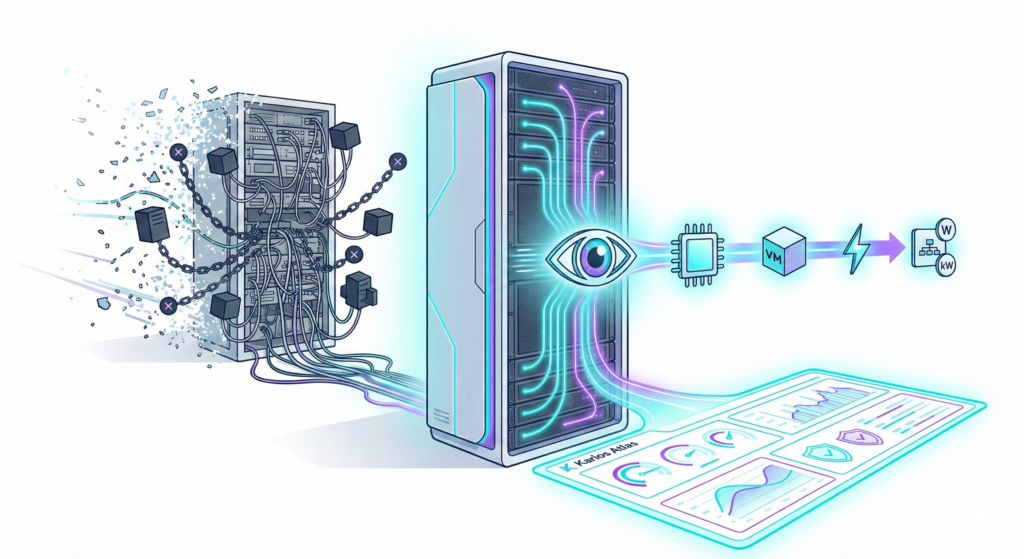
For decades, observability has been treated as an external add-on. Enterprises deploy agents, sidecars, exporters, and collectors on top of already complex infrastructure, increasing cost, operational risk, and performance overhead. The result is telemetry sprawl, duplicated data, and monitoring stacks that consume a meaningful portion of the very compute they are meant to observe.
Karios takes a fundamentally different approach. By operating as a unified infrastructure control plane, Karios Core provides native visibility into compute, storage, networking, and platform state without relying on per-workload agents. Observability is not bolted on. It is a natural outcome of owning the infrastructure lifecycle end to end.
The result is reduced overhead, clearer root cause analysis, and infrastructure that is measurable by design rather than instrumented after the fact.
Modern infrastructure suffers from a structural visibility gap between hardware, virtualization, and workloads. To compensate, organizations assemble multiple monitoring tools, each focused on a narrow layer of the stack. This approach introduces two systemic problems.
Guest-level agents and collectors consume CPU cycles, memory, storage I/O, and network bandwidth. In dense virtualized or Kubernetes environments, this overhead compounds quickly, driving up infrastructure cost while delivering diminishing insight.
Most monitoring tools operate inside the guest or container boundary. They can report symptoms such as CPU pressure or I/O latency, but they lack visibility into underlying causes such as hypervisor scheduling behavior, storage contention, firmware state, or physical resource constraints.
As regulatory and operational requirements increase, these blind spots become more than an inconvenience. They create audit gaps, slow incident response, and complicate compliance validation.
Karios Core is a unified infrastructure operating system that manages virtualization, Kubernetes, and bare-metal resources from a single control plane. Because Karios controls provisioning, orchestration, and lifecycle management, it can observe infrastructure behavior directly, without embedding agents into workloads.
Observability in Karios is derived from control and state awareness, not invasive instrumentation.
Karios Core captures metrics and events at the infrastructure layer, including compute utilization, storage performance, network behavior, and platform health, without requiring software agents inside virtual machines or containers.
By maintaining awareness of hardware inventory, hypervisor state, and workload placement, Karios can correlate performance behavior across layers. This enables faster identification of whether an issue originates in the workload, the virtualization layer, or the underlying infrastructure.
Karios Atlas provides a consolidated view of infrastructure state, inventory, utilization, and operational events. Instead of reconciling conflicting dashboards from separate tools, operators work from a single source of truth that reflects how the infrastructure is actually configured and running.
True operational visibility goes beyond logs and metrics. It includes energy behavior and security posture as first-class concerns.
When deployed with Karios PowerLink, infrastructure power consumption becomes observable alongside compute and workload metrics. This enables correlation between energy usage and infrastructure activity, supporting efficiency analysis, capacity planning, and power-aware scheduling strategies.
Karios Core includes native security assessment capabilities through Karios Shield. Using infrastructure-level insight, Karios can validate configuration and platform state against established standards such as OpenSCAP. This approach emphasizes continuous posture visibility rather than after-the-fact scanning.
By reducing dependence on third-party monitoring agents and collectors, organizations can reclaim compute capacity and simplify tooling sprawl.
Cross-layer visibility shortens time to root cause by eliminating guesswork between infrastructure, platform, and operations teams.
Infrastructure-level logging, inventory awareness, and configuration visibility simplify compliance preparation for frameworks such as NIST, PCI-DSS, and HIPAA.
Telemetry bloat is a symptom of fragmented infrastructure ownership. When observability is layered on after the fact, it inevitably adds cost, complexity, and blind spots.
Karios demonstrates that when infrastructure is managed as a coherent system, visibility becomes native, efficient, and actionable. Observability is no longer a tax on performance. It is an inherent property of the platform.
Stop managing agents. Start operating infrastructure with clarity.