
As enterprises grapple with rising licensing costs, shifting support models, and an accelerating appetite for edge and AI workloads, many datacenter teams now ask a simple question: “What makes for an enterprise ready VMware Alternative?”
For large‑scale operators, the answer is rarely a “like‑for‑like” hypervisor swap. Instead, it’s a search for an infrastructure platform that:
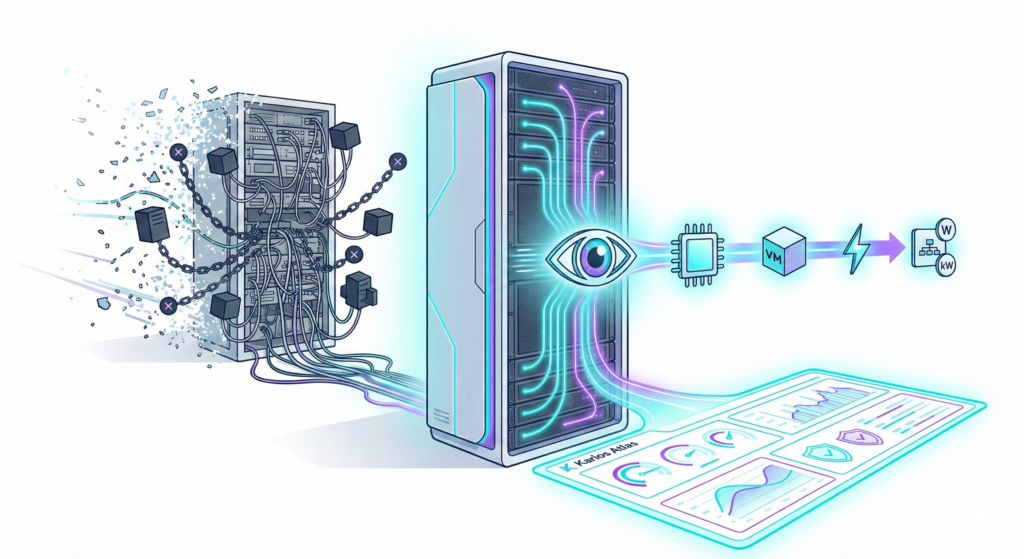
Karios positions itself precisely at that intersection. It’s the first Infrastructure Operating System of its kind, engineered for the modern AI-enabled datacenter.
VMware has long anchored the enterprise virtualization world. Yet recent shifts, including new subscription licensing, uncertainty around the vSphere roadmap, and growing edge and AI demands have pushed many CIOs to evaluate alternatives.
Enterprises typically care about:
These criteria set a high bar. Any replacement must support mission critical workloads with AI in mind, and must make it easier to justify any new infrastructure spend.
An effective VMware alternative should deliver more than “cheap‑hypervisor” substitution. Modern datacenters demand:
These requirements describe not just yet another hypervisor, but a reimagined datacenter management layer and that’s where an Infrastructure Operating System like Karios comes in.
Karios is the world’s first Infrastructure Operating System, purpose-built to unify compute, storage, networking, power intelligence, security, and lifecycle automation into a single, coherent control fabric. It eliminates fragmented toolchains, legacy licensing complexity, and bolt-on dependencies by treating infrastructure itself as an operating system layer, not a collection of loosely integrated products.
At the center of the platform is Karios Core, the control plane of the Infrastructure Operating System. It delivers:
Native support for mixed virtual machine and Kubernetes workloads within the same cluster
Rather than managing a stack of separate hypervisors, storage controllers, SDN overlays, and monitoring agents, operators interact with a single control surface. The result is reduced operational friction, faster change cycles, and tighter integration across workloads and environments.
Infrastructure efficiency is determined not only by runtime performance, but by how easily it can be deployed and managed at scale.
Karios Forge, the zero-touch provisioning engine within the Infrastructure Operating System, provides:
This approach replaces bespoke scripting, manual staging, and vendor-specific toolchains with a standardized, policy-driven fabric that operates consistently across environments.
Traditional infrastructure platforms manage CPU and memory utilization but lack awareness of real-time electrical and thermal conditions. This blind spot often leads to circuit overloads, inefficient cooling, and underutilized compute capacity.
Karios PowerLink, integrated into the Infrastructure Operating System, introduces real-time energy intelligence
Rather than managing a stack of separate hypervisors, storage controllers, SDN overlays, and monitoring agents, operators interact with a single control surface. The result is reduced operational friction, faster change cycles, and tighter integration across workloads and environments.
In modern enterprises, security and governance cannot exist as optional add-ons. They must be inherent to the infrastructure layer.
Karios Shield, integrated within the Infrastructure Operating System, delivers:
Auditors and governance teams receive structured, evidence-based reporting rather than manual artifacts. Infrastructure controls are mapped directly to business risk requirements, enabling compliance to be demonstrated systematically across datacenter, cloud, and edge deployments.
Karios is designed for enterprises that:
Karios is not simply an alternative hypervisor or a new hyperconverged appliance. It is a deliberate redefinition of how infrastructure is designed and operated.
By integrating orchestration, observability, energy intelligence, security, and lifecycle automation into a unified Infrastructure Operating System, Karios transforms datacenter and edge environments into programmable, intelligent, and policy-driven platforms built for modern workloads.