Modernizing the Edge: Transforming Remote and Constrained Environments with Karios Cube
Enterprise infrastructure no longer resides solely within centralized datacenters. Critical workloads now operate in clinics, manufacturing plants, retail branches, telecom towers, public safety facilities, and rural government sites. These environments often lack redundant power, dedicated IT staff, and controlled climate conditions. Yet they are expected to deliver the same reliability and security as core infrastructure.
Modernizing the edge requires more than smaller servers. It requires an architectural rethink.
This model is no longer sustainable.
AI clusters, high-density virtualization, and distributed edge environments are pushing power envelopes to their limits. Energy constraints are now architectural constraints. To move forward, power must evolve from a passive utility into an active control plane.
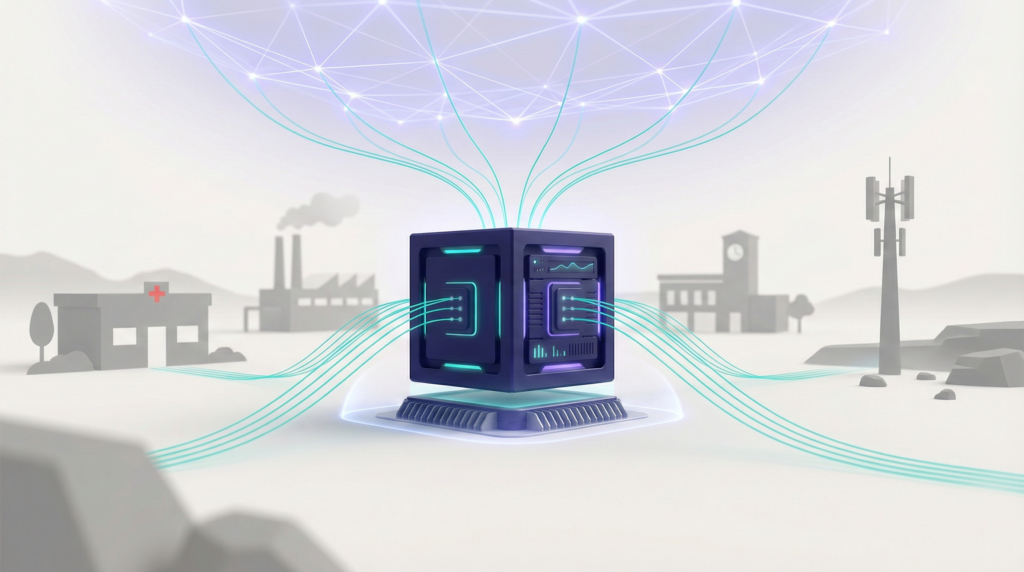
The Edge Constraint Problem
Traditional infrastructure assumes stable power, conditioned space, and continuous connectivity. Edge locations rarely provide these guarantees. They may experience intermittent bandwidth, limited physical security, environmental stress, and constrained rack space.
As a result, organizations frequently deploy fragmented solutions at the edge. Standalone appliances handle networking. Separate systems manage compute. Backup and monitoring are centralized and reactive. When issues arise, remediation is delayed due to geographic distance and limited onsite expertise.
This model increases operational risk and reduces service continuity.
A Purpose-Built Edge Platform
Karios Cube was engineered to address these realities. Rather than adapting traditional datacenter infrastructure for remote environments, Karios Cube delivers a self-contained, high-density compute platform designed specifically for edge deployment.
Karios Cube can be deployed in two primary configurations:
- A fully enclosed, thermally protected system with integrated cooling, capable of operating in challenging environmental conditions and supporting off-grid deployments
- A modular pod that integrates directly into standard racks, featuring its own enclosed cooling loop, high-speed storage, and optimized compute density
Both configurations are built to maximize performance while minimizing energy consumption, supporting modern CPUs and GPUs with a focus on power efficiency.
Unified Control at the Edge
Modernization at the edge requires more than hardware resilience. It requires consistent control.
Each Karios Cube runs under the same Infrastructure Operating System that governs centralized clusters. Virtual machines and Kubernetes workloads operate within a unified orchestration fabric. Security posture validation, telemetry, and lifecycle management are embedded directly into the system.
This means that remote sites are not isolated silos. They are extensions of the enterprise control plane.
Policies defined centrally are enforced consistently across edge nodes. Observability is continuous. Updates and configuration changes are declarative and automated. Operational consistency reduces the need for onsite intervention while increasing reliability.
Efficiency Beyond Electricity
Modern edge infrastructure must support diverse, mission-critical workloads:
- Rural healthcare systems requiring localized data processing
- Educational institutions delivering digital learning platforms
- Public safety and first responder coordination
- Telecom expansion into underserved regions
- Industrial and agricultural monitoring systems
Karios Cube enables these environments to operate autonomously while remaining integrated with the broader enterprise ecosystem.
From Fragile Sites to Autonomous Nodes
Edge modernization is often approached as a cost containment exercise. In reality, it is a strategic opportunity.
By deploying an integrated, energy-efficient, and self-contained compute platform under a unified Infrastructure Operating System, organizations transform remote locations into autonomous digital nodes. Reliability increases. Operational overhead decreases. Innovation expands into regions previously considered too complex or costly to support.
The future of enterprise infrastructure is distributed.
Modernizing the edge is not optional. It is foundational.