
For more than two decades, enterprise infrastructure has evolved through incremental layering. Hypervisors were added to physical servers. Storage arrays were abstracted. Networking was virtualized. Security, backup, observability, disaster recovery, and automation were then bolted on as separate control planes. The result was not modernization. It was accumulation.
Today’s datacenter is often a carefully balanced stack of licensing agreements, vendor dependencies, and operational workarounds. Each layer may function independently, yet collectively they create cost volatility, management complexity, and strategic rigidity. Modern workloads, especially AI, distributed applications, and edge deployments, expose these structural weaknesses.
True modernization requires a shift in model, not another tool.
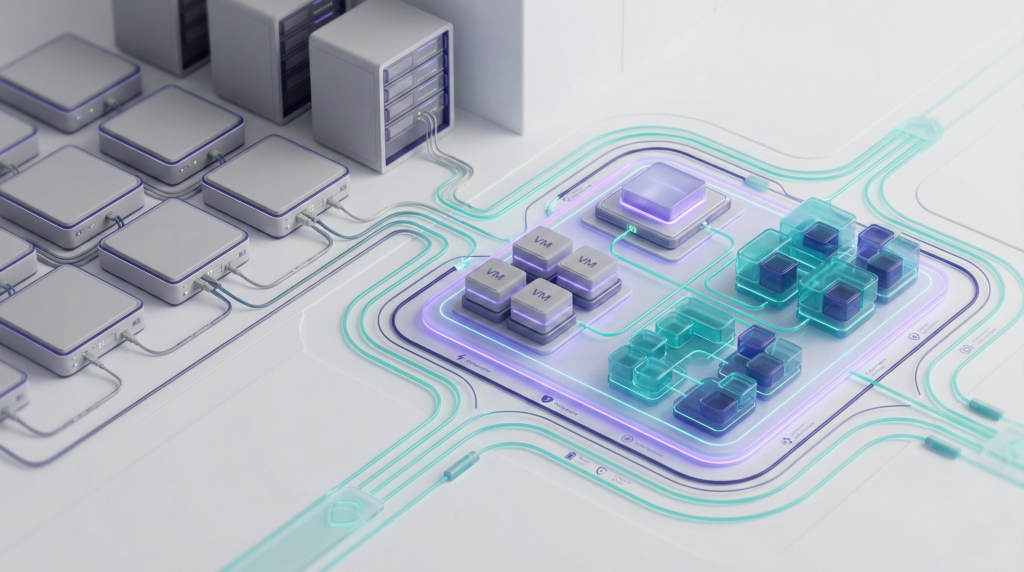
Legacy architecture treats infrastructure as a collection of products. Compute is one system. Storage is another. Networking and security sit adjacent. Automation is an overlay. Observability is an afterthought. Each component introduces its own lifecycle, support contract, upgrade cadence, and cost structure.
This fragmentation produces three systemic challenges:
Enterprises attempting to modernize within this model often find themselves migrating from one vendor dependency to another, without reducing overall complexity.
Karios introduces a fundamentally different approach: infrastructure as a unified operating system.
Instead of stacking products, Karios integrates virtualization, container orchestration, storage management, networking, security posture validation, disaster recovery, observability, and lifecycle automation into a single coherent control fabric. This architecture is not an aggregation layer. It is a native platform.
With Karios Core at the center, compute, storage, and networking are treated as programmable resources within a declarative system. Workloads, whether virtual machines or Kubernetes clusters, operate on the same substrate. Security scanning, telemetry, and policy enforcement are embedded functions rather than external agents.
The result is a system that behaves more like an operating system than a collection of utilities.
Modernization does not require disruptive rip-and-replace strategies. A structured transition includes:
Unify management of compute, storage, and networking into a single declarative environment. Reduce operational sprawl before attempting workload transformation.
Enable mixed VM and container workloads to coexist under one orchestration layer. This protects legacy applications while supporting modern development models.
Eliminate agent sprawl by integrating telemetry and compliance scanning directly into the infrastructure fabric.
Modern infrastructure must address energy efficiency and hardware utilization. Integrated power optimization and AI-driven lifecycle control convert infrastructure from a static cost center into a dynamically managed asset.
Modern enterprises operate beyond the core datacenter. A unified Infrastructure Operating System allows consistent policy and automation across centralized clusters and distributed edge environments.
The goal of modernization is not simply technical improvement. It is strategic control.
By transitioning from a layered legacy stack to a unified Infrastructure Operating System, enterprises regain architectural clarity. Licensing becomes predictable. Operational workflows become programmable. Security posture becomes continuous rather than periodic. Energy use becomes measurable and optimizable.
Most importantly, infrastructure shifts from reactive maintenance to proactive orchestration.
Modernization is no longer about choosing the next hypervisor. It is about redefining the substrate upon which the enterprise runs.
Karios was built to make that shift possible.