
Virtualization transformed enterprise computing. By abstracting hardware from workloads, hypervisors enabled consolidation, improved utilization, and simplified provisioning. For years, this model defined what modernization meant.
However, what began as an efficiency breakthrough has gradually become an architectural constraint. Enterprises today are not struggling with virtualization itself. They are constrained by a hypervisor-centric model that was never designed to manage modern infrastructure complexity.
The time has come to evolve beyond virtualization as the center of gravity.
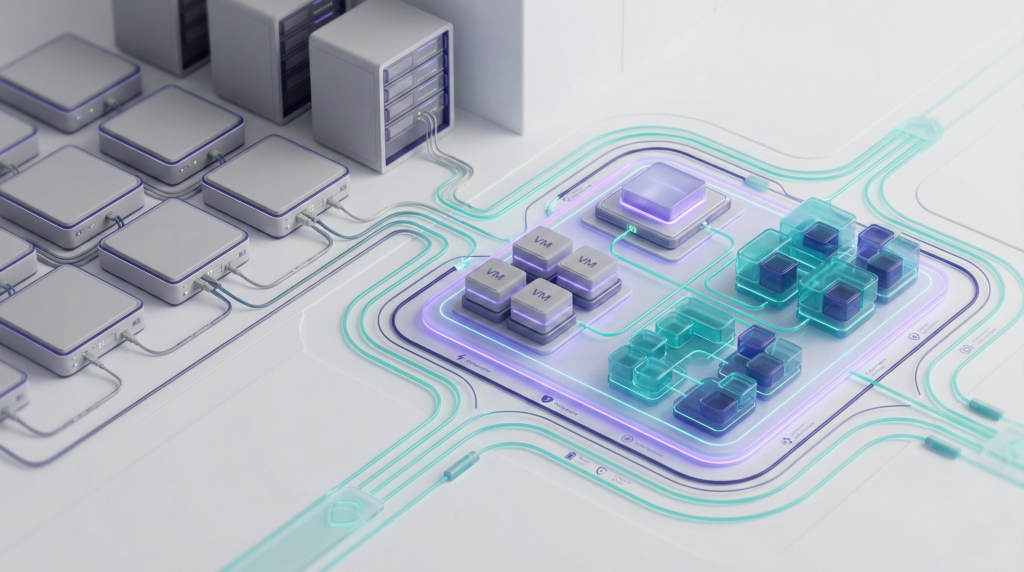
Traditional infrastructure places the hypervisor at the core of the stack. Everything else, storage, networking, backup, security, observability, and automation, is layered around it. As requirements expanded, vendors introduced plugins, extensions, and external systems to compensate for gaps.
Over time, this model created several structural issues:
Virtual machines remain important, but they are no longer the only or even primary workload model in many enterprises. Yet organizations continue to architect around a hypervisor-first mindset.
The result is friction.
Virtualization should be treated as a capability within infrastructure, not the foundation of infrastructure strategy.
Modern enterprises require a unified substrate capable of running mixed workloads, automating lifecycle management, optimizing power consumption, enforcing security posture, and extending consistently from core datacenter to distributed edge. A standalone hypervisor does not provide that framework.
What is required is an integrated control fabric.
Karios addresses this challenge by redefining the architecture. Instead of centering infrastructure around a hypervisor, Karios Core functions as a true Infrastructure Operating System. Virtual machines and Kubernetes clusters operate within the same orchestrated environment. Compute, storage, and networking are managed as a single programmable resource pool. Observability and compliance scanning are embedded rather than bolted on.
Virtualization remains present, but it is no longer the organizing principle.
The hypervisor trap is not only architectural. It is financial.
Many enterprises are discovering that their infrastructure roadmap is effectively dictated by renewal cycles and vendor pricing strategies. Migration decisions are driven less by technical merit and more by cost escalation or licensing uncertainty.
When infrastructure is built around a single virtualization vendor, flexibility becomes limited. Hardware choices narrow. Integration paths harden. Strategic autonomy diminishes.
A unified Infrastructure Operating System restores control. It decouples operational design from single-product dependency and allows enterprises to build around capabilities rather than contracts.
Modern infrastructure must support:
These requirements exceed the scope of a hypervisor.
Escaping the hypervisor trap does not mean abandoning virtualization. It means placing virtualization in its proper context as one component within a broader, intelligent infrastructure fabric.
Enterprises that make this shift move from managing virtual machines to orchestrating infrastructure as a system. They reduce fragmentation, regain financial predictability, and position themselves for long-term agility.
Virtualization defined the last era of infrastructure.
An Infrastructure Operating System defines the next.