
Traditional disaster recovery strategies assume one constant: the datacenter survives.
Backup sites, replication clusters, and secondary facilities are designed around geographically separated but structurally similar environments. This model works when disruptions are localized. It struggles when power grids fail, facilities become inaccessible, or regional events disrupt multiple locations simultaneously.
Modern resilience requires more than a secondary rack. It requires mobility.
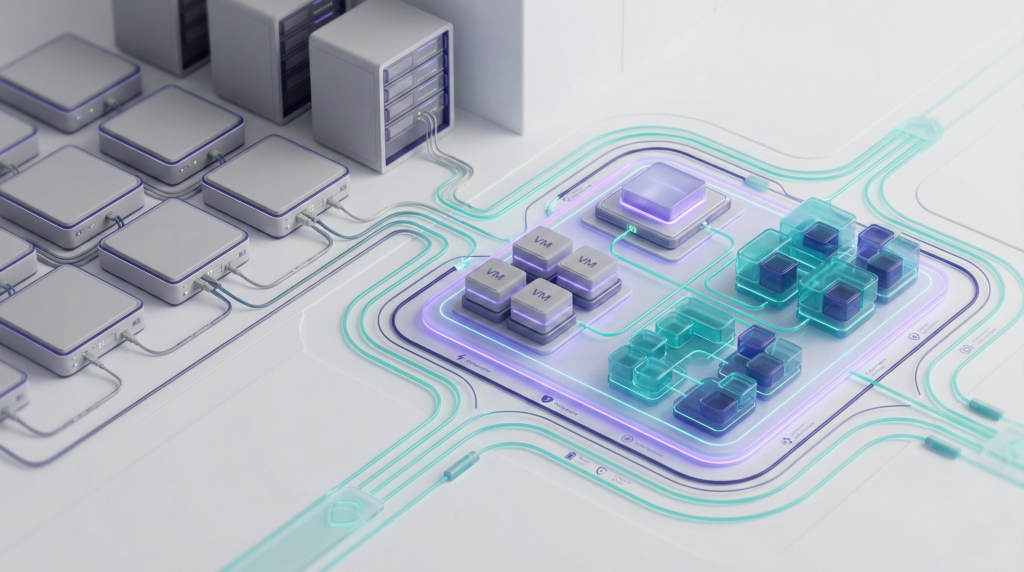
Conventional disaster recovery depends on:
These assumptions increase cost and reduce flexibility. Many organizations underinvest in secondary sites due to capital constraints, leaving them exposed when disruption occurs. Even when backup facilities exist, recovery time objectives can be delayed by logistical constraints and infrastructure dependencies.
Disaster recovery should not rely on the same assumptions as primary infrastructure.
Karios Cube is engineered to function outside conventional datacenter conditions. Integrated cooling, environmental protection, and energy-efficient compute allow it to operate in constrained or temporary environments.
This capability supports:
Instead of waiting for infrastructure to be rebuilt, organizations can restore services wherever power and connectivity can be established.
Recovery time objectives are often dictated by infrastructure readiness. Portable compute dramatically shortens this timeline.
Because Karios Cube runs the same Infrastructure Operating System as centralized clusters, policy enforcement, workload orchestration, and security posture remain consistent. Data replication and workload snapshots can be restored directly onto the Cube without translation between disparate platforms.
The result is reduced recovery time and improved confidence in continuity plans.
Traditional DR architectures duplicate infrastructure. Karios Cube enables dynamic redeployment of infrastructure.
Organizations no longer need to maintain underutilized secondary facilities to achieve resilience. Instead, they gain portable, autonomous compute that can operate within a rack during normal operations and transition off-grid during emergencies.
Disaster recovery becomes an operational capability rather than a static location.
In an era of increasing environmental, geopolitical, and infrastructure volatility, continuity must be flexible.
True resilience is not built into buildings.
It is built into architecture that can move.