
Renewal shock is not merely a budgeting inconvenience. It is a structural vulnerability.
When infrastructure strategy is anchored to vendor licensing cycles, long-term
architectural control erodes.
It is time to move beyond reacting to renewals and toward designing infrastructure that
you actually control.
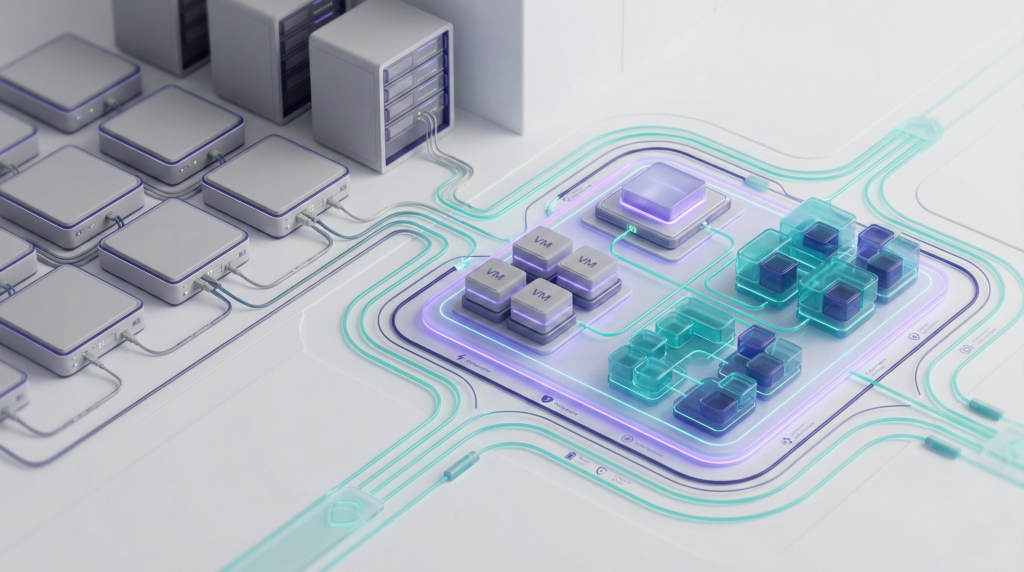
Traditional infrastructure models center on a dominant virtualization platform
surrounded by ancillary products. Over time, this core dependency shapes hardware
choices, integration pathways, and operational workflows. Switching becomes
increasingly complex as tooling, skills, and processes align around the incumbent stack.
When renewal terms shift, enterprises face constrained options:
None of these outcomes represent strategic control.
Dependency becomes embedded not only in contracts but also in architecture.
True control is achieved when infrastructure design is independent of any single
product’s pricing model. This requires a shift from stack-centric thinking to a unified,
programmable substrate.
Karios was built to embody that shift. As the world’s first Infrastructure Operating
System, Karios integrates virtualization, Kubernetes orchestration, storage, networking,
security posture validation, disaster recovery, and lifecycle automation into a cohesive
control fabric.
Instead of layering products with separate renewal cycles, Karios consolidates
capability under a unified architecture. Virtual machines and container workloads
operate within the same declarative environment. Observability and compliance are
embedded functions rather than external dependencies.
This architectural integration reduces exposure to fragmented licensing volatility.
Infrastructure control is not only technical. It is financial.
When management planes are unified, budgeting aligns with capability rather than
product sprawl. Enterprises gain visibility into total cost of ownership across compute,
storage, networking, and power consumption. Licensing becomes simpler and more
predictable because it reflects a consolidated platform rather than a collection of
interdependent agreements.
Predictability enables strategic planning. It restores alignment between infrastructure
investment and business objectives.
Modern workloads demand flexibility. AI clusters require dense compute and optimized
power management. Edge deployments require autonomy and consistent policy
enforcement. Security posture must be continuous rather than periodic.
Designing infrastructure that you control means selecting an architectural model that
can evolve without forcing disruptive replatforming every time a contract changes.
An Infrastructure Operating System provides that foundation. It abstracts complexity
while preserving flexibility. It enables mixed workloads without architectural
compromise. It embeds intelligence into the fabric rather than layering it externally.
Most importantly, it shifts decision-making power back to the enterprise.
Renewal shock is a symptom of a deeper issue: infrastructure dependency by design.
The path forward is not to negotiate better renewals. It is to build infrastructure around a
unified system that you govern.
Control is not purchased at renewal time.
It is engineered into the architecture from the start.