
For decades, enterprise IT has operated in a reactive mode. Alerts trigger investigation. Performance degradation prompts manual tuning. Security scans uncover drift after policies have already been violated. Capacity planning occurs in response to growth rather than in anticipation of it.
This operational posture was manageable when environments were smaller and workloads were predictable. It is no longer sustainable.
AI workloads, distributed edge deployments, regulatory pressure, and energy constraints demand a new operating model. Infrastructure must evolve from reactive oversight to autonomous orchestration.
Traditional IT operations rely on threshold-based monitoring and ticket-driven workflows. Systems generate alerts. Engineers analyze logs. Remediation steps are applied manually or through scripted automation. This approach introduces delay, variability, and human dependency at precisely the moment stability is most critical.
As environments scale, alert fatigue increases. Multiple monitoring tools compete for attention. Observability agents consume compute resources simply to report on system health. Security posture assessments are periodic rather than continuous.
The result is operational noise rather than operational intelligence.
Autonomous infrastructure requires intelligence embedded directly within the infrastructure layer. Rather than layering analytics on top of disparate systems, the control plane itself must understand workload behavior, resource utilization, and policy state in real time.
Karios was designed with this principle in mind. As the world’s first Infrastructure Operating System, Karios Core integrates telemetry, lifecycle automation, and policy enforcement natively within the orchestration fabric.
Because observability is built into the system rather than bolted on, visibility is continuous and low-overhead. Desired state is defined declaratively. The system evaluates compliance and performance dynamically, not just when an alert crosses a threshold.
This foundation enables AI-driven operational insights to act on unified data rather than fragmented signals.
The shift to autonomy is not simply about faster alert resolution. It is about proactive optimization.
Integrated resource scheduling allows compute, storage, and networking to be balanced intelligently across clusters. Power visibility and control enable infrastructure to adapt based on utilization patterns, improving energy efficiency and reducing unnecessary overhead. Security posture validation runs continuously, reducing exposure windows and improving compliance readiness.
Instead of waiting for incidents, the system adjusts preemptively.
AI training clusters, high-density GPU deployments, and edge nodes operating in constrained environments require more than traditional monitoring. They demand real-time orchestration, predictive scaling, and intelligent lifecycle management.
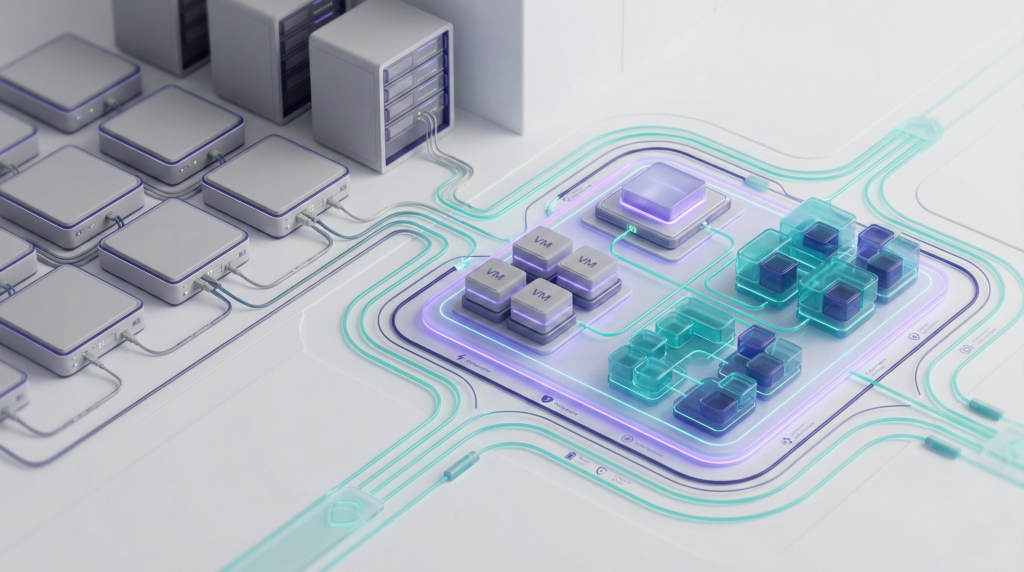
An Infrastructure Operating System provides a unified substrate where these capabilities can operate cohesively. Virtual machines and container workloads coexist under a single policy framework. Automation workflows apply consistently across datacenter and edge deployments.
This alignment reduces mean time to resolution, improves reliability, and increases confidence in operational resilience.
Reactive IT consumes resources. Autonomous infrastructure creates leverage.
By embedding AI-driven operations into the infrastructure fabric, enterprises reduce manual intervention, lower operational overhead, and gain predictable performance across environments. Innovation accelerates because teams spend less time troubleshooting fragmentation and more time building strategic capabilities.
The transition from reactive to autonomous operations is not incremental. It is architectural.
As infrastructure complexity continues to grow, organizations must decide whether to manage noise or to orchestrate intelligence.
The future belongs to systems that can manage themselves.