For many enterprises, modernization is no longer optional. Licensing volatility, aging hardware, security exposure, and the demand for AI-ready infrastructure are forcing decisive action. Yet modernization initiatives frequently stall for one reason: migration risk.
Legacy applications often support core business processes. They were built years ago, sometimes decades ago. They may depend on specific hypervisor versions, storage architectures, or network configurations. Replatforming these systems introduces operational risk that few organizations are willing to accept.
Modernization fails when it is approached as a disruptive event. It succeeds when it is executed as a controlled evolution.
Traditional migration strategies assume a binary choice: remain on legacy infrastructure or replace it entirely. This mindset leads to large-scale cutovers, extended testing windows, and parallel environments that inflate cost and complexity.
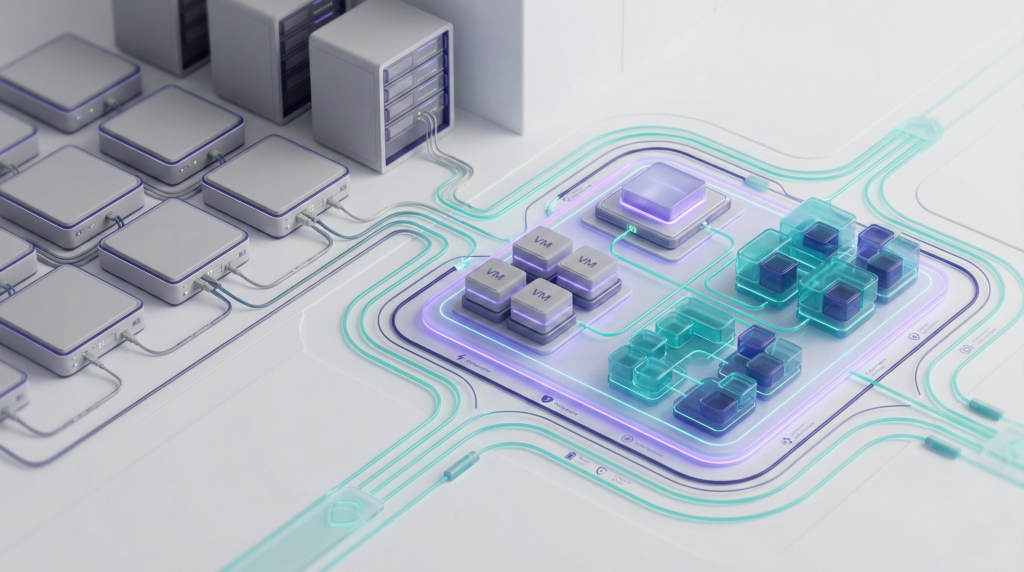
In practice, enterprises need a transitional architecture that supports coexistence. Virtual machines must continue to run reliably. Containerized workloads must expand. Security posture must improve. Observability must deepen. All without destabilizing production systems.
This requires a unified control plane that can absorb legacy workloads while enabling modern orchestration.
Karios was designed precisely for this transitional reality. As the world’s first Infrastructure Operating System, Karios Core provides a unified substrate capable of running traditional virtual machines and modern Kubernetes clusters within the same orchestration fabric.
This architecture enables a phased replatforming strategy:
Rather than forcing legacy workloads to adapt to fragmented modernization tools, Karios consolidates control and provides architectural continuity.
Migration risk is often driven by configuration drift and manual intervention. Karios reduces this exposure by implementing declarative infrastructure management. Desired state is defined once and enforced across the environment.
Security posture scanning is embedded directly into the infrastructure layer, eliminating the need for agent sprawl and improving compliance visibility during transition. Observability is native, allowing operators to monitor workload health and performance without introducing additional overhead.
This approach transforms migration from a sequence of manual tasks into a controlled orchestration process.
Legacy workloads frequently depend on predictable performance characteristics. Karios maintains workload isolation and resource governance while improving visibility into power consumption and utilization.
Through integrated lifecycle automation and intelligent resource scheduling, infrastructure capacity can be optimized without jeopardizing production stability. This is particularly important for enterprises preparing for AI workloads or high-density compute scenarios while still maintaining mission-critical legacy systems.
The most successful modernization initiatives do not culminate in a single cutover date. They establish a platform that allows continuous improvement.
With Karios, enterprises gain:
Modernization no longer requires chaos. It requires consolidation of control and strategic evolution of the underlying substrate.
By replatforming workloads into an Infrastructure Operating System rather than another fragmented stack, enterprises move forward without destabilizing what already works.
Modernization becomes deliberate, controlled, and aligned with long-term architectural goals rather than short-term disruption.