
For decades, infrastructure teams have treated power as a fixed input. Servers consume electricity. Cooling systems compensate. Capacity planning assumes worst-case utilization. Power is monitored at the facility level, but rarely controlled at the workload level.
This model is no longer sustainable.
AI clusters, high-density virtualization, and distributed edge environments are pushing power envelopes to their limits. Energy constraints are now architectural constraints. To move forward, power must evolve from a passive utility into an active control plane.
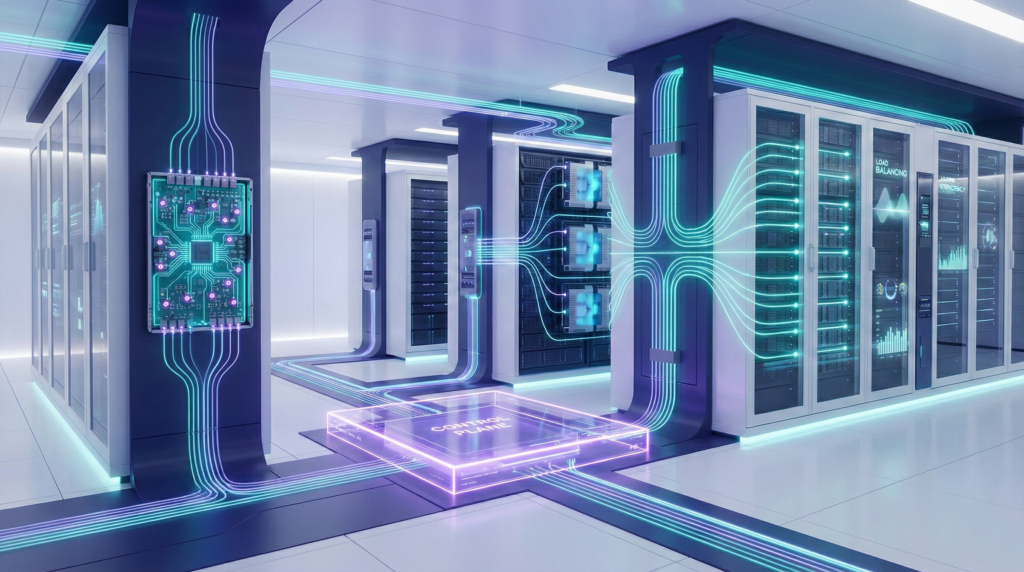
Traditional datacenter management provides limited visibility into power at the node or workload level. Operators see aggregate rack consumption or facility draw, but they lack granular, real-time insight into how specific workloads impact energy usage.
Without embedded intelligence, power optimization becomes reactive. Overprovisioning is common. Cooling demand rises unnecessarily. GPU clusters are constrained not by compute capability, but by electrical and thermal ceilings.
Power inefficiency directly limits workload density.
Karios addresses this challenge by integrating power management directly into the Infrastructure Operating System.
Karios PowerLink is a hardware module that integrates directly into the power supply of a single server or node. Unlike external monitoring tools, PowerLink operates natively within the Karios Core control fabric.
This integration enables:
By embedding power awareness directly into orchestration decisions, smaller server deployments can achieve measurable efficiency gains. Instead of provisioning based on static assumptions, Karios dynamically aligns workload placement with available power capacity.
The result is up to 55 percent improvement in infrastructure efficiency when compared to traditional, unmanaged environments.
For large-scale server deployments and AI clusters, Karios Kinetic extends this concept to rack and cluster levels. Supporting up to 48 current transformer connections, Kinetic provides multi-node, multi-circuit visibility across high-density environments, including NVIDIA GPU-based AI systems.
In AI deployments, power and thermal headroom often dictate performance ceilings. Kinetic enables:
Instead of scaling infrastructure blindly, operators can extract additional compute performance from existing power envelopes.
Power optimization has cascading effects.
Reduced electrical draw lowers cooling requirements, which in turn decreases water consumption in facilities that rely on evaporative cooling. Lower energy consumption directly reduces carbon intensity, particularly in regions with fossil-fuel-based grids.
By integrating power intelligence into the orchestration layer, Karios aligns operational efficiency with sustainability objectives. Efficiency gains are not limited to cost savings. They support ESG mandates and long-term environmental goals.
Most power tools monitor. Karios controls.
By treating power as a first-class resource within the Infrastructure Operating System, Karios PowerLink and Karios Kinetic transform energy from a constraint into an optimization lever. Virtualization density increases. AI clusters run closer to their true capacity. Energy waste declines.
In a world where compute demand is accelerating and energy supply is constrained, infrastructure advantage will belong to those who can orchestrate watts as intelligently as workloads.
Power is no longer just consumption.
It is a control plane.