
Every three to five years, enterprises face the same decision: refresh aging hardware or extend it another budget cycle. Traditional hardware replacement strategies follow a predictable pattern. Servers reach end of support. Performance declines. Power consumption rises. Maintenance contracts become more expensive. A new rack of equipment is ordered, installed, and the cycle begins again.
This model assumes infrastructure is static. Modern demands prove otherwise.
AI workloads, distributed operations, energy constraints, and resilience requirements have changed what a hardware refresh must accomplish. Replacing like for like is no longer sufficient. Organizations need infrastructure that is denser, more energy-efficient, and adaptable to both centralized and distributed environments.
A refresh should not simply replace hardware. It should upgrade architecture.
Legacy refresh cycles often replicate the same structural inefficiencies:
Once installed, traditional rack servers are effectively immobile assets. If organizational needs change, whether due to expansion, contraction, relocation, or crisis response, hardware remains fixed in place.
Capital becomes stranded.
Karios Cube redefines the hardware refresh model. Rather than replacing aging rack servers with similar static equipment, Karios Cube delivers high-density, energy-efficient compute in a modular form factor designed for flexibility.
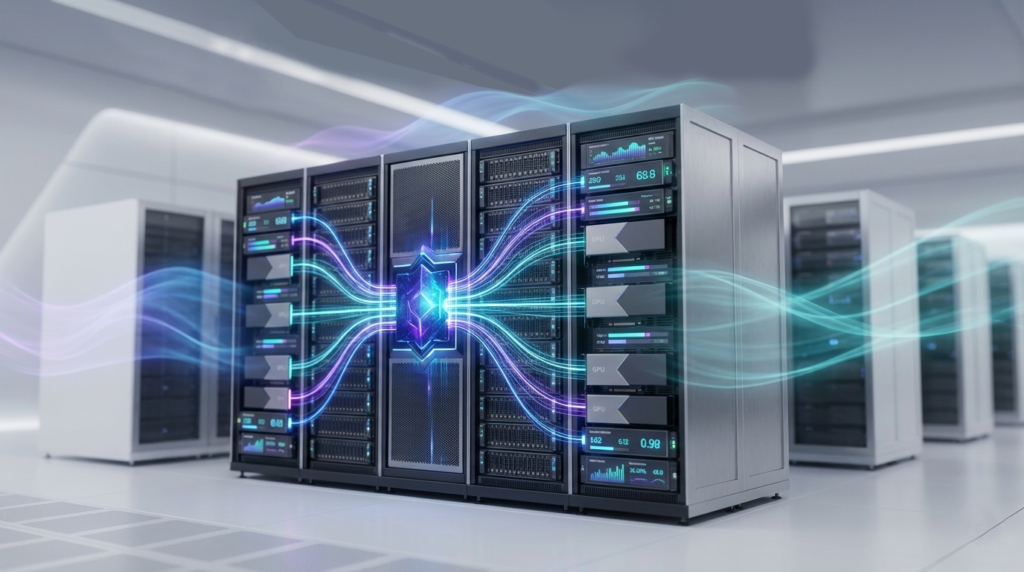
Karios Cube can be deployed directly into a standard rack, operating as a high-performance node with its own enclosed cooling loop, high-speed storage, and optimized compute density. It maximizes modern CPU and GPU capabilities while minimizing power consumption.
What differentiates Karios Cube is mobility.
The same Cube operating in a rack environment can be removed and redeployed in a fully enclosed, thermally protected configuration capable of operating off-grid. Integrated cooling and environmental protection allow it to function in constrained or remote environments without reliance on traditional datacenter infrastructure.
This transforms infrastructure from fixed capital into portable capability.
Replacing legacy servers with Karios Cube does more than modernize hardware specifications. It improves operational efficiency:
Organizations achieve greater workload density without expanding rack space or increasing power draw proportionally.
In many environments, this translates into significant reductions in energy waste and improved infrastructure utilization.
A hardware refresh should not be a reactive purchase driven by warranty expiration. It should be an opportunity to align infrastructure with future demands.
With Karios Cube, enterprises gain:
The refresh cycle becomes a modernization cycle.
Infrastructure is no longer confined to a single physical context. It becomes deployable wherever compute is needed, without sacrificing density, efficiency, or control.
Replacing legacy hardware is inevitable.
Replacing it with flexible, deploy-anywhere infrastructure is a strategic choice.