Security patch cycles and compliance audits have long been treated as necessary disruptions rather than integral parts of infrastructure operations.
Karios Shield redefines this model by embedding security directly into the infrastructure layer, shifting organizations away from reactive remediation toward continuous, proactive protection.
By integrating OpenSCAP scanning natively into the hypervisor, Karios Shield removes the need for third-party agents and automates remediation for up to 95% of identified vulnerabilities. The result is always-on security that is built in, cost-efficient, and operationally unobtrusive.

Modern infrastructure environments are rarely designed holistically. Organizations purchase servers, layer on a hypervisor, then add separate security scanners, compliance tools, and endpoint agents. Over time, these components accumulate into a fragile and expensive patchwork. Each update introduces new compatibility risks, and operational complexity grows with every additional tool.
This approach raises an obvious question. Why is the system responsible for running the data center not also responsible for protecting it?
Karios Shield was created to answer that question by making security a native function of the infrastructure itself.

System administrators consistently cite agent sprawl as a major operational burden. Endpoint agents consume resources, introduce conflicts, and become increasingly difficult to manage at scale.
Karios Shield eliminates this problem by operating natively at the hypervisor layer within Karios Core. No software agents are required on virtual machines or workloads. The infrastructure continuously scans itself.
Because security controls operate below the guest operating system, Karios Shield provides visibility that external scanners often miss, including firmware-level issues and deep configuration drift. This foundation-level perspective enables more accurate assessments with far less operational overhead.
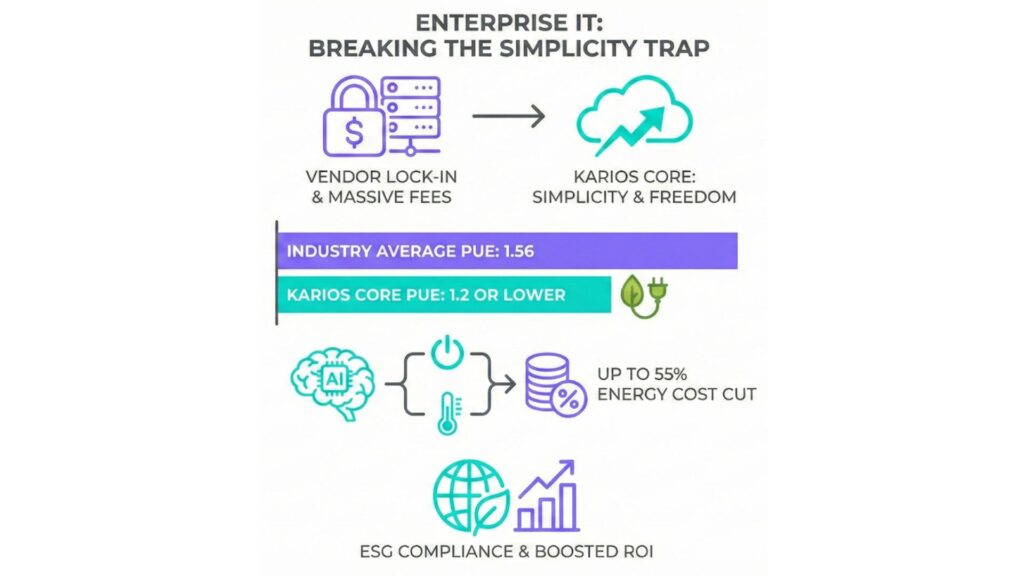
In many legacy platforms, advanced security capabilities are positioned as premium add-ons. Organizations pay higher licensing fees, then incur additional costs for third-party tools to achieve meaningful protection.
Karios Shield rejects this model. Security is not an optional upgrade. It is a baseline requirement.
Compliance scanning aligned with widely adopted frameworks such as STIGs, PCI-DSS, and HIPAA is included from the moment the platform is deployed. By consolidating security into the core infrastructure, organizations can materially reduce total cost of ownership, often by more than 40 percent, simply by removing redundant products and licensing.
For decades, security has been treated as a gatekeeper that slows progress and adds friction. Karios Shield reverses that dynamic by making security the foundation that enables speed, resilience, and scale.
There is no need for another dashboard or another layer of agents. What is required is infrastructure that actively protects itself. That is the principle behind Karios Shield, developed by Karios, and it is how modern infrastructure security should operate.