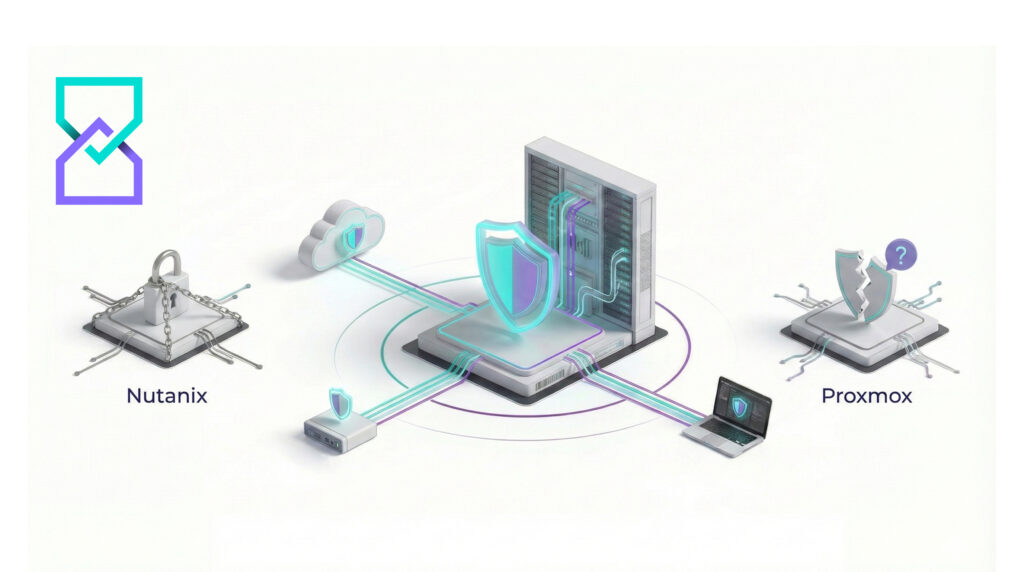
The post-acquisition disruption of the virtualization market in 2025 triggered a large-scale reassessment of infrastructure strategy. Many organizations migrated toward Nutanix in pursuit of perceived enterprise stability, while others adopted Proxmox to regain flexibility and licensing freedom. By 2026, both paths have revealed material constraints.
Nutanix customers are encountering renewal cost escalation and restricted hardware optionality, particularly as AI and accelerator refresh cycles accelerate. Proxmox adopters, while benefiting from openness, are confronting the realities of operational risk, limited automation, and support models that do not align with production-grade AI and mission-critical workloads.
Karios introduces a third, pragmatic path. It is a unified infrastructure operating system designed to combine enterprise reliability, hardware agnosticism, and operational automation without imposing artificial licensing or hardware constraints.
AI-driven workloads, edge deployments, and energy-aware computing have shifted infrastructure requirements from incremental optimization to systemic efficiency. Platforms optimized for traditional virtualization models are increasingly misaligned with these demands.
AI-driven workloads, edge deployments, and energy-aware computing have shifted infrastructure requirements from incremental optimization to systemic efficiency. Platforms optimized for traditional virtualization models are increasingly misaligned with these demands.
Customer benchmarks and partner analyses consistently show widening cost deltas during refresh cycles. Licensing models tied to node counts and certified configurations can drive refresh costs multiple times higher than functionally equivalent open or hybrid architectures.
Nutanix remains tightly coupled to a defined hardware compatibility model. While this approach simplifies support, it limits the ability to adopt emerging AI CPUs, GPUs, and power-efficient platforms on customer timelines.
Proxmox remains a capable open-source virtualization platform, but it was not designed as a full lifecycle infrastructure system.
High-density GPU workloads increase sensitivity to kernel stability, memory pressure, and driver lifecycle management. These challenges are solvable, but they require deep operational expertise and bespoke automation outside the core platform.
Proxmox’s community-driven support model can be effective for many environments, but it does not provide built-in operational guardrails, lifecycle automation, or deterministic response mechanisms required for regulated or always-on production systems.
Karios is built around the principle that infrastructure should be operated as a cohesive system, not as a collection of loosely integrated tools.
Karios Core functions as an infrastructure operating system that spans bare metal, virtualization, and Kubernetes from a single control plane. It is hardware-agnostic by design and supports standard x86 and ARM-based platforms without vendor-imposed certification tiers.
Zero-touch provisioning workflows enable rapid onboarding of servers and edge systems, reducing deployment timelines from weeks to hours or minutes depending on environment readiness.
Atlas provides continuous discovery, inventory, and lifecycle management across the infrastructure estate. Hardware is managed using industry-standard interfaces such as Redfish and platform management technologies, enabling remote visibility and control without dependence on proprietary tooling.
By embedding DCIM-style telemetry directly into the platform, Karios eliminates the need for parallel asset tracking, power monitoring, and infrastructure visibility systems.
AtlasFlow introduces policy-based automation and analytics across infrastructure operations. Rather than relying solely on reactive alerting, the system correlates telemetry, configuration drift, and workload behavior to surface early indicators of operational risk.
This approach supports proactive maintenance, capacity planning, and controlled remediation workflows without requiring manual intervention for every anomaly.
Karios Shield embeds security into the infrastructure lifecycle rather than treating it as a post-deployment activity. Native OpenSCAP-based scanning supports alignment with common regulatory frameworks, including NIST and ISO standards.
Compliance validation occurs continuously alongside infrastructure operations, reducing reliance on manual hardening processes and external scanning tools.
| Capability Area | Nutanix | Proxmox | Karios |
|---|---|---|---|
| Primary Constraint | Cost escalation and hardware lock-in | Operational maturity at scale | None by design |
| Hardware Flexibility | Certified platforms only | Broad, manual qualification | Any standards-based x86 or ARM |
| Provisioning Model | Guided, but manual | Manual or scripted | Zero-touch, policy-driven |
| AI and GPU Operations | Supported, vendor-aligned | Possible, operator- dependent | Supported with lifecycle controls |
| Energy and Power Visibility | Limited | External tooling | Native telemetry and optimization |
| Security Compliance | External products required | Manual configuration | Native OpenSCAP integration |
| Operational Remediation | Ticket-driven | Community-driven | Automated and policy-based |
By 2026, infrastructure decisions are no longer about choosing between “enterprise” and “open.” They are about operational control, financial predictability, and the ability to evolve with hardware, energy, and workload demands.
Karios removes the forced trade-off between cost certainty and operational rigor. It delivers a unified, hardware-agnostic platform that treats infrastructure as a continuously managed system rather than a static deployment.
For technology leaders, this represents a durable exit strategy from both licensing volatility and operational fragility. Infrastructure becomes simpler, more adaptive, and aligned with the realities of modern AI-driven environments.