
Enterprise infrastructure rarely fails because of a single catastrophic flaw. It erodes value quietly through accumulated complexity. Over time, what appears to be a modern environment becomes a patchwork of tools, contracts, plugins, and operational dependencies. Each component may serve a purpose. Collectively, they impose a hidden tax.
This tax does not appear as a single line item on a budget. It manifests as duplicated licensing, excess compute overhead, renewal volatility, operational inefficiency, and energy waste. Fragmented infrastructure extracts cost from the organization in ways that are often accepted as normal.
It should not be.
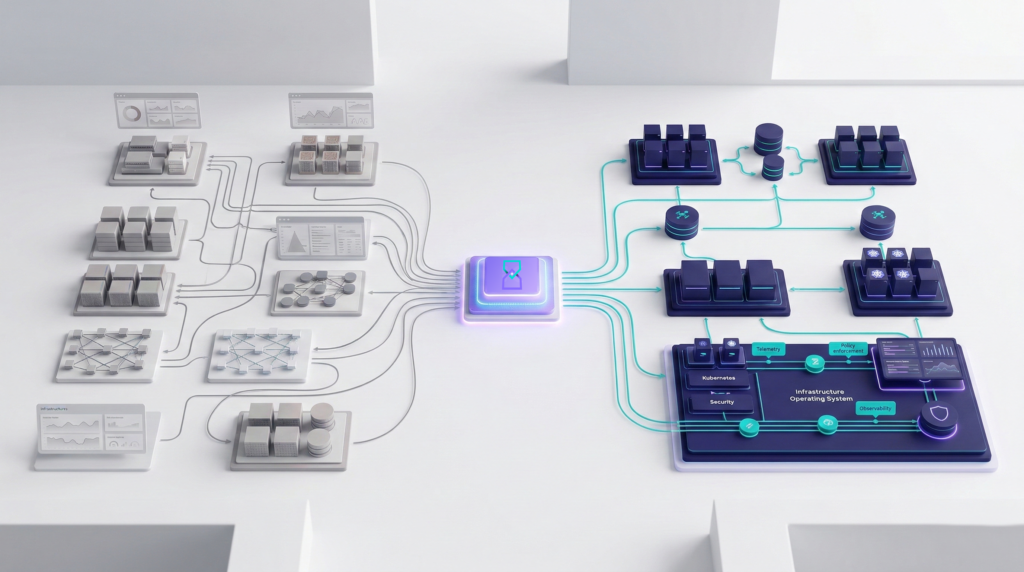
In a fragmented model, enterprises license virtualization separately from storage management, separately from backup, separately from disaster recovery, separately from observability, and separately from security posture scanning. Each product introduces its own pricing model and renewal schedule.
Over time, renewal cycles become negotiation events rather than operational decisions. Budget predictability declines. Architecture becomes shaped by contract terms instead of technical requirements.
The organization is no longer optimizing infrastructure. It is managing vendor relationships.
Beyond cost, fragmentation creates friction.
Multiple control planes require specialized expertise. Routine changes involve coordination across teams and systems. Troubleshooting spans disparate dashboards and logging tools. Policy enforcement must be replicated across platforms.
Monitoring agents consume compute resources simply to observe performance. Security tools operate out of band, introducing latency and overhead. Automation becomes a scripting exercise rather than a native capability.
These inefficiencies increase mean time to resolution, slow innovation, and reduce confidence in infrastructure resilience.
Modern infrastructure must account for power consumption and hardware utilization. In fragmented environments, energy visibility is limited and optimization is reactive. Underutilized hardware remains powered and cooled because integrated telemetry does not exist to drive intelligent lifecycle decisions.
As compute density increases, particularly with AI workloads, this blind spot becomes more costly.
Karios was designed to eliminate fragmentation at the architectural level. As the world’s first Infrastructure Operating System, Karios integrates virtualization, Kubernetes orchestration, storage, networking, disaster recovery, security validation, observability, and lifecycle automation into a single cohesive fabric.
Instead of layering products, Karios Core unifies control.
Compute, storage, and networking are managed declaratively. Telemetry is embedded natively, eliminating agent overhead. Security posture scanning operates within the infrastructure layer rather than as an external dependency. Power visibility and optimization are integrated into the system rather than treated as an afterthought.
This integration produces measurable outcomes:
Fragmented infrastructure treats IT as a maintenance function. A unified Infrastructure Operating System transforms it into a strategic asset.
By eliminating the hidden tax, enterprises regain financial clarity, operational simplicity, and architectural flexibility. Innovation accelerates because teams are no longer reconciling disparate systems. Budgeting stabilizes because costs align with capability rather than renewal pressure.
The hidden tax of fragmentation has been tolerated for years because no alternative existed that unified control without sacrificing flexibility.
Karios was built to change that equation.
Infrastructure should be an operating system, not a collection of invoice