
Thermal Autonomy: Patented Cooling for High-Density Compute in Extreme Environments

In today’s globalized and digitally connected world, compute infrastructure must extend beyond the confines of traditional datacenters. High‑density workloads are increasingly being deployed in deserts, mountains, remote villages, and disaster zones. Conventional cooling methods optimized for controlled environments struggle under these conditions, resulting in degraded performance, reduced hardware lifespan, and critical service outages.

Karios has developed patented thermal management innovations that ensure thermal autonomy for compute infrastructure, delivering reliable performance in extreme temperature environments. By combining advanced materials, intelligent cooling, and integrated energy management, our system enables high‑density compute nodes to thrive in areas where legacy datacenter solutions fail.
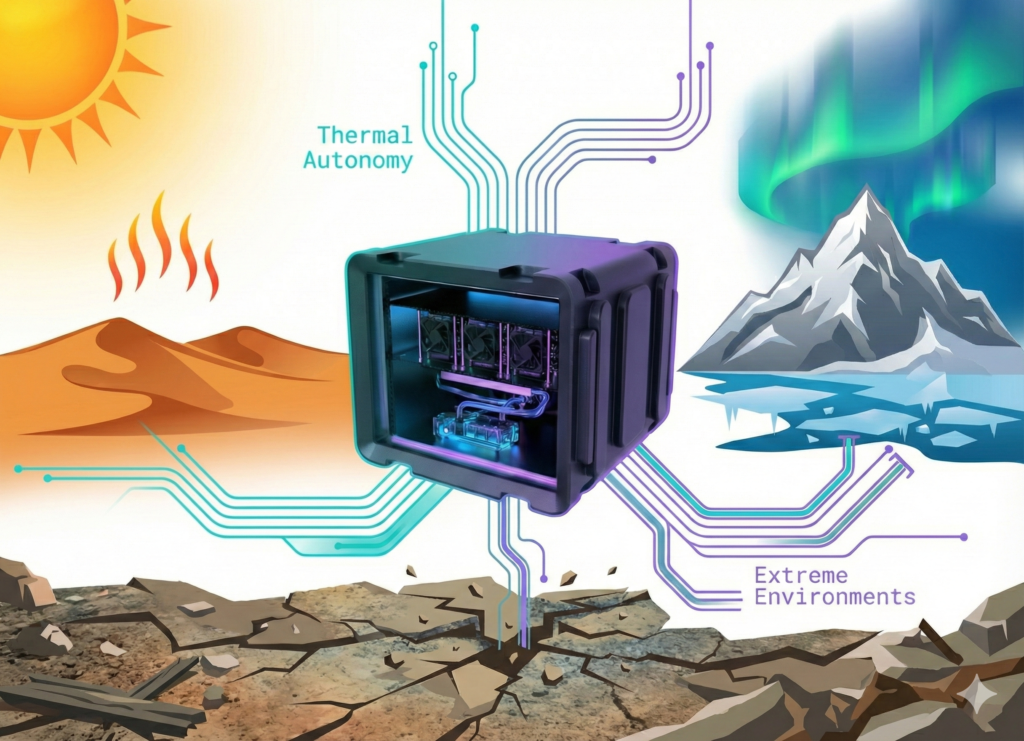
The Challenge of Extreme Environments

  • Desert Deployments: Ambient temperatures exceeding 50°C (122°F), dust, and sand infiltration.
  • Mountain Deployments: Thin air reduces the efficiency of traditional convection‑based cooling, compounded by fluctuating temperature extremes.
  • Disaster Zones: Rapid deployment into unstable environments with unreliable power, debris, or temporary shelters.

Traditional air‑conditioned cooling approaches are impractical or impossible in these scenarios due to high energy requirements, infrastructure limitations, and the lack of sealed, climate‑controlled facilities.

Our Patented Thermal Management System

1. Adaptive Heat Dissipation

  • Phase‑change thermal materials for rapid absorption and release of heat during workload spikes.
  • Micro‑channel liquid cooling that minimizes fluid volume while maximizing heat transfer efficiency.
  • Dust‑resistant sealed enclosures with passive thermal venting.

2. Autonomous Thermal Intelligence

  • Real‑time thermal sensors integrated at chip, board, and chassis levels.
  • AI‑driven workload orchestration based on thermal conditions -moving workloads between nodes to optimize cooling capacity.
  • Predictive analytics to anticipate overheating events and self‑adjust cooling profiles.

3. Energy‑Efficient Cooling

  • Hybrid cooling modes: passive convection, liquid cooling, and smart fans that engage only when necessary.
  • Karios PowerLink integration ensures real‑time energy audits, enabling operators to balance cooling loads against compute performance.
  • Optimized for solar and battery backup systems, sustaining cooling without grid dependency.

4. Ruggedized Deployment

  • Engineered for wide operating ranges (–20°C to +60°C).
  • Withstands dust storms, high humidity, and altitude shifts.
  • Portable design fits into our 2ft x 2ft x 2ft “modular micro-datacenter” -deployable by vehicle, drone, or even manual carry.
  •  

Benefits of Thermal Autonomy

  • Extreme Reliability: Hardware runs at optimal thermal levels even under punishing climates.
  • Energy Efficiency: Reduced reliance on air conditioning or external infrastructure.
  • Mobility: Systems can be relocated quickly without complex environmental dependencies.
  • Sustainability: Enables solar‑powered and carbon‑auditable operations with minimal environmental footprint.
  • Security & Compliance: Integrated hardware‑level security remains uncompromised by overheating risks.

Use Cases

  • Defense and Military: Tactical compute in deserts, mountains, or forward operating bases.
  • Emergency Response: Pop‑up datacenters in disaster zones supporting communications, logistics, and medical coordination.
  • Telecom Expansion: Remote base stations and 5G edge nodes requiring reliable compute.
  • Scientific Research: Mountain observatories, desert energy test sites, and arctic research stations.
  • Developing Regions: Solar‑powered datacenter deployments in rural communities with minimal infrastructure.

Conclusion

Our patented thermal management technology delivers true thermal autonomy, enabling high‑density compute to operate in the harshest climates on earth. By ensuring optimal cooling without the need for traditional datacenter infrastructure, our innovation redefines the possibilities of edge computing, bringing resilient, sustainable, and secure compute power to deserts, mountains, and disaster zones.

The future of compute is not limited by geography. With thermal autonomy, the edge can be anywhere.